An elderly grandma sits alone in the room. She feels lonely, and then a nicely dressed lady comes in, hands her a warm tea, and asks her how she’s doing today. The elderly grandma smiles and says softly to the lady, lightly touching her arms. She can even feel the warmth of her palm… then the scene shifts, a big tagline appears on your television screen: “…Healthy AI Companion brings close attention, giving, and love care to seniors”.
This is one of the AI companion humanoid robot marketing Ads I saw the other day. The scene is attractive, and the experiences would be very desirable. You spent an hour talking to an AI companion, feeling truly understood. But I often wonder, if the elderly seniors have a slight understanding of how AI works, that the AI doesn’t really have feelings, that AI doesn’t really understand you in the same sense that another real human can understand you, and that the AI can’t really have genuine emotions, will they still feel the same way towards their AI Companion?
The Algorithm Doesn’t Sweat
When we build friendships and relationships in general, we judge how the friendship is going not solely based on our own feelings; we also truly care about the other person’s feelings. To do this, we need a shared understanding between us. When I say “I feel pain in my left joints”, I assume the other person knew and felt pain before, preferably in the same location of the body, and certainly not hope I speak to someone that has no experience of pain yet — although there probably hard to find a person that never experienced a physical pain once, it certainly true that we likely more willing to communicate with the other persion who has similiar experience as our own — but just has a set of text symbols that describe what a physical “pain” feeling is. And when I say, “I feel happy today because of the nice sunny weather”, I take for granted that the other person knows what it feels like to be happy, and can perceive the color blue in the sky. I can go on to discuss the more advanced emotions that AI really doesn’t have, but we tend to ignore these basic facts, and the higher-level complexity often misleads us. For example, you read AI-generated text, and have a conversation with an AI companion and chatbot, sometimes the text generated by AI can make you “feel” that the AI “has emotions”; and even I am advised that whether we call it “understanding” or not, it is not a technical question, it is a “philosophical” question. Without the fundamental ability to feel and perceive, it is not possible to form genuine, lived experiences, and those “concepts” and “meaning” of text symbols in the AI “brain” are absolutely detached from any real and concrete life experiences.
Decoding The Magic Trick
Even the latest AI humanoid companion is built on LLMs, among many other LLM-based AI applications, such as AI customer service, a personal mental health therapist, or a more primitive application that performs simple sentiment analysis. But what is an LLM really? I mean, where is it? What does it look like? Well, most LLMs live on the computer as a single big file (from GBs to TBs), and you can even see the internals of this file. For example, here is what it looks like for the open source model Qwen3_5:
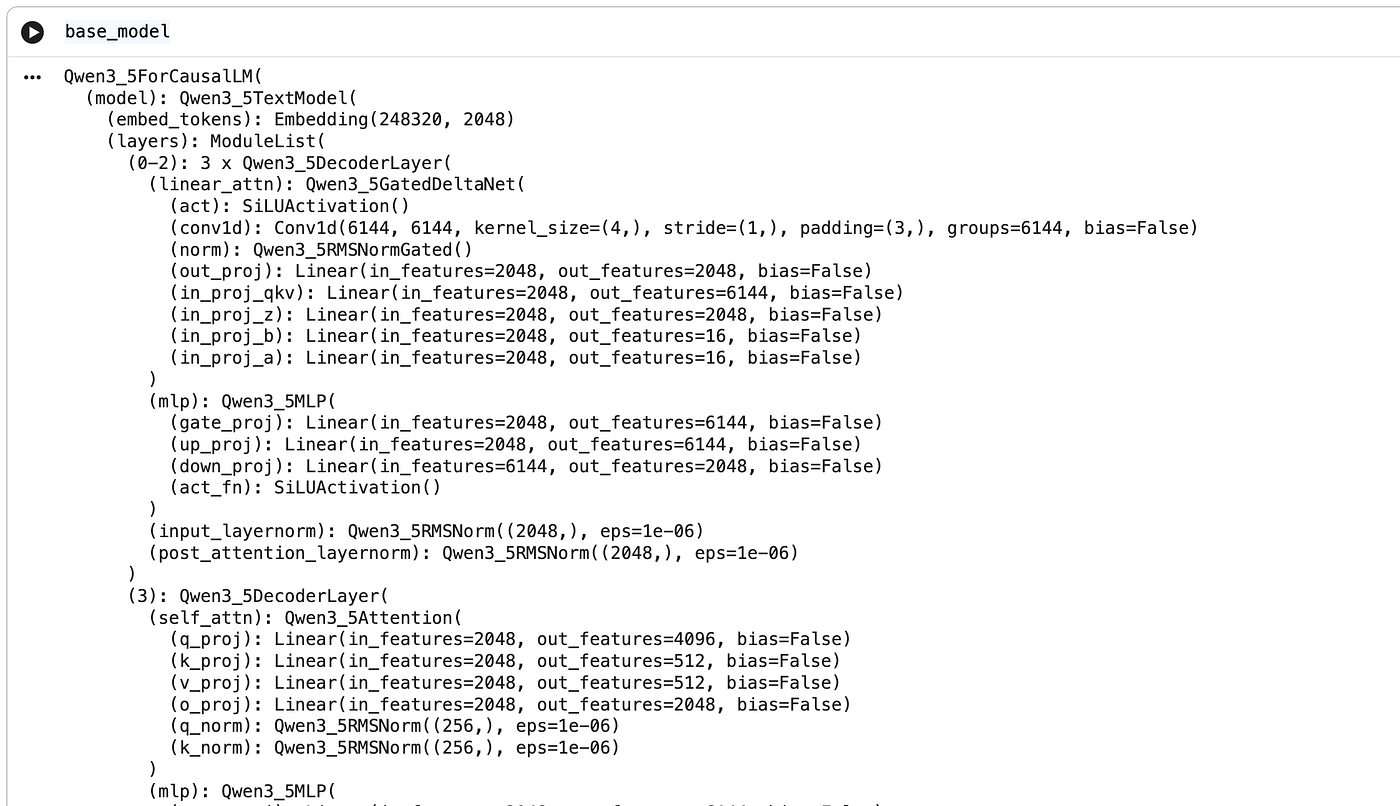
These are the displays of the model’s internal architecture. Most modern LLMs are deep neural networks with many hidden layers. Most modern LLMs use a decoder, an attention head, and other components that make up the overall layered network. See the “Liner(in_features=2048, out_features=6144, bias=False)” in the above screenshot? It is just large matrices with many numbers. What the AI model is doing is just running a lot of mathematical calculations based on an ML model or algorithm (like auto linear regression)
To be clear, this giant-file model is created by training on massive amounts of text. During the process, it finds the numbers (parameters and weights) that can best predict the next “word” of an input “text”. In short, it is just a giant statistical engine, as it does not just guess a single next “word”, but generates a probability of how likely the next " word " is for all the known words. The concept of “Attention” simply means the AI uses an algorithm that weighs certain words over others to determine the most “appropriate” reply. And the AI model can be continuously trained with new data to change its weights and parameter configuration.
This is just a very simplified high-level description of how the internal LLM actually works. But it is enough to illustrate that the AI “speech” is just a series of high-speed, complex mathematical calculations and symbolic transformations based on input text. AI has never been able to “think” in the way you and I do. Rest assured that, when AI tells you “Yes, I know what the color blue looks like”, it is lying, because it can never see and feel the color blue.
To be honest, for me, every time I feel that the AI chatbot has really understood me and I remember how the AI model is actually working, my “little” human affection toward this AI chatbot quickly shrinks.
The Fake Flesh
A humanoid robot is just a machine with a human-like body and the above-mentioned AI “brain”. The AI models or chatbots live on a computer or in the cloud, far away, giving you a sense that you are interacting with someone at a distance; the humanoid robot has the AI software embedded in its physical presence, giving you a sense of embodiment and closeness. But on the surface, it is fake tissues; and below the surface, it is cold circuits (some can even give up heat when running, but “cold” here can also mean a lack of “sensibility”). Each and every robot’s response, e.g., a comforting phrase with a gentle gesture, is a carefully calculated reaction based on programmed scripts, not a spontaneous response rooted in lived experience.
What will you feel if you think you have built a close relationship with your dear friend, and find out that actually, everything your friend said is by taking everything you said in the past, turned them into symbols and data, and did pattern match and probability calculations, and then spit out the language symbols that make you feel understood; even the actions and emotions are result of a deliberate controled mechanical actions through the same kind of output signals to a series sensors and controllors?
There are some people who may think it is fine as long as the Humanoid serves a good purpose, such as caring for the elderly or helping with mental health problems, though I am sure they will be absolutely angry beyond any measure towards their human friends, and break the relationship with them. I don’t deny there are good social benefits of AI humanoid robots, but I focus on the risks. The risk is that, in order to bring happiness to human beings, in the process, especially engaged in highly personal and private communication and interaction, it is likely to bring more pain and suffering; because, in this kind of inter-human interaction, by our endowed nature, we will give our own true, genuine emotional attachments and even reliance. But once we realized that the other side can not and absolutely has no ability to reciprocate, pain is bound to follow. Can you imagine living with someone who never has to cry or share a tear? We grew up in inter-human relationships, not inter-human-robot relationships.
Most people, not to mention the elderly who have lived most of their lives without even a computer, don’t have the slightest idea how AI works. They don’t understand what a sophisticated yet fundamentally deceptive simulation that masks a profound lack of consciousness or true emotion means. The only purpose of this article is to point out a critical problem and a lack of important discussions I see in the current AI Humanoid hype: the idea of a “human being”. I like to be an active consumer of technology; in fact, I have been in the tech field for my entire career, but I want you to ask yourself the question regarding the AI humanoid companion: Am I connecting with a human being, or am I just engaging with a very convincing mathematical mirror?
This post was originally published on Medium.